By Blaine Hadfield
A conflict that burdens the ethics of technology is the abstruse nature of technology itself. People are becoming less and less aware of how technology functions within particular applications of industry. As technology becomes better equipped to serve the specific requirements of an industry, it is more difficult to maintain up-date knowledge on the normative role of technology in a broad sense. Furthermore, the progression of technology loads the task of informing oneself with greater difficulty. So that it is not just the case that people are less informed about technology, but that it is more difficult to become so informed. To the extent that this is true, a conversation vis-à-vis the ethics of technology is outside of what most people can speak intelligently about.
Technology is powerful enough to rub up against issues of real ethical consequence. Today’s technology isn’t just exploring how to build a more efficient refrigerator, it seeks to extend life, end life, and grant real intelligence to the tools of our own creation. The problem is that as technology increases in capability, a person seems to be able to say less about the tasks that technology ought to serve. This results because of two reasons. One, people are less informed about what technology can accomplish. For example, there are many who would regard as science fiction the creation of biological robots that, when introduced into the blood stream, may perform medical tasks therein. Yet, nanotechnology is at the moment of this kind of creation. The second reason is that the ethical issues themselves are increasingly nuanced. A person says less about the morality of technology because they are less sure of their own ethical opinions regarding technology as it ought to be employed. For example, a person may have a strong ethical opinion about murder. We should not actively cause death to another. However, medical technology has the power to sustain life. And to the extent that it does, technology gives scenarios that may or may not constitute murder. Whichever stance a person wishes to assume on this issue, they are usually less inclined to maintain the position with the same fervor that would characterize their opinion on murder that is cold blooded. The point is that technology allows for nuanced ethical scenarios; the morality of which people are less decided about.
Thus, it seems as though our technology has outpaced our ethics. In which case, what kind of technology shall slide around our ethical thinking as that thinking fails to understand technology? Is it even possible that technology should be stalled for ethics? How does one legislate for such a pause when one does not understand the purposiveness of technology nor find agreement in ethics? These are difficult questions and yet these conditions are already set into play. And so, we have arrived. We have arrived and are without the answers.
Tuesday, March 20, 2007


Monday, March 12, 2007
Student Reponse to Joanne Milner's Lecture
By Robert Nelson Follett
Joanne R. Milner was the guest speaker at the cultural seminar on March 7, 2007. As a representative in the state legislature, she has helped represent many ethnic minorities here in the state of Utah. In her presentation, she mentioned a man who was a pivotal exemplar: Grandpa Pete Montoya, an older Hispanic man that showed her the importance of public service. He always cared for those around him and treated them better than himself. He grew produce on a tract of land and always gave the best of the crop to everyone around him and kept the worst for himself. She mentions that it was his example that taught her public service.
She also mentioned that whether we care to admit it or not, it’s a fact our economy is dependent on the Hispanic populations. They are hard workers and do the jobs that a lot of us (societal America) don’t want to do. Many times I’ve thought about the idea that they do the jobs we don’t want to do, but yet we complain that they are encroaching on our jobs and making jobs scarce. I grew up in southeast Idaho and there are a lot of farms that are dependent on the Hispanics in the area. As many businesses move in to the area, many white young adults go and work at these businesses, thus making a shortage of workers for the farms. Who steps up to the plate to take the jobs that we don’t want? The Hispanics. They work hard and do the “low jobs” our society is dependant upon. Rather than judging on skin color or a surname, we should understand the importance these people play in our society and then judge them according to their actions. After all, as long as a job gets done and gets done well, who cares if Rob or Roberto did it?
Joanne R. Milner was the guest speaker at the cultural seminar on March 7, 2007. As a representative in the state legislature, she has helped represent many ethnic minorities here in the state of Utah. In her presentation, she mentioned a man who was a pivotal exemplar: Grandpa Pete Montoya, an older Hispanic man that showed her the importance of public service. He always cared for those around him and treated them better than himself. He grew produce on a tract of land and always gave the best of the crop to everyone around him and kept the worst for himself. She mentions that it was his example that taught her public service.
She also mentioned that whether we care to admit it or not, it’s a fact our economy is dependent on the Hispanic populations. They are hard workers and do the jobs that a lot of us (societal America) don’t want to do. Many times I’ve thought about the idea that they do the jobs we don’t want to do, but yet we complain that they are encroaching on our jobs and making jobs scarce. I grew up in southeast Idaho and there are a lot of farms that are dependent on the Hispanics in the area. As many businesses move in to the area, many white young adults go and work at these businesses, thus making a shortage of workers for the farms. Who steps up to the plate to take the jobs that we don’t want? The Hispanics. They work hard and do the “low jobs” our society is dependant upon. Rather than judging on skin color or a surname, we should understand the importance these people play in our society and then judge them according to their actions. After all, as long as a job gets done and gets done well, who cares if Rob or Roberto did it?
Friday, March 09, 2007
Joanne Milner
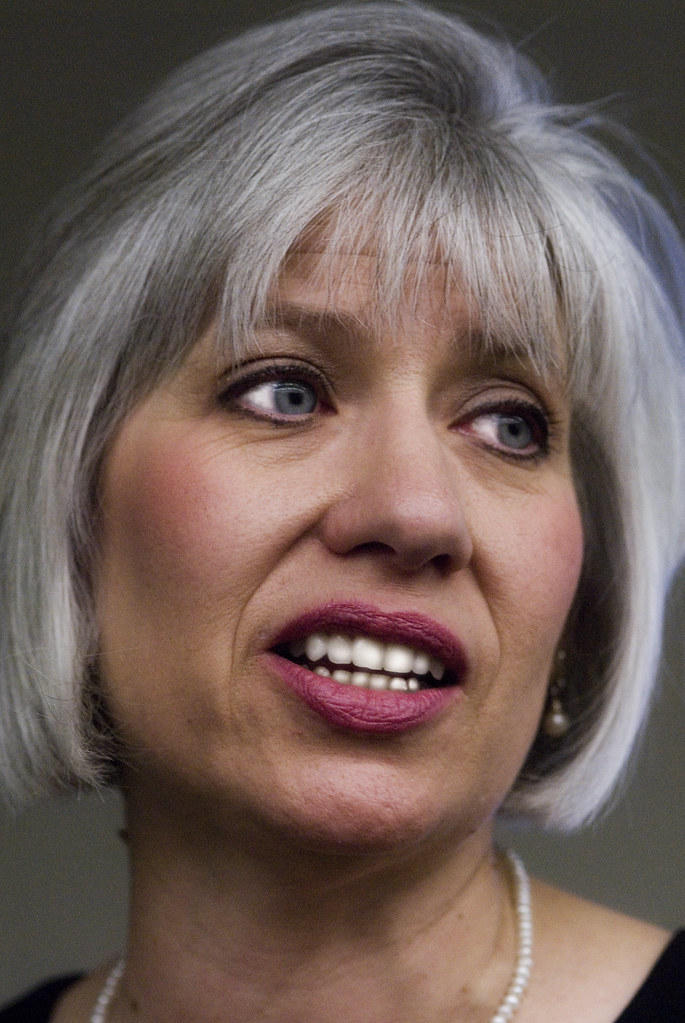
On March 7th at 7 p.m the Center for the Study of Ethics welcomed Joanne Milner as its Monthly Ethics Forum speaker. Ms Milner is the Community Relations Program Manager at Salt Lake City School's Horizonte Instruction and Training Center and she hosts and produces a show on KRCL called "Cultural Connections". Biographical information about her is listed below this post.
Ms. Milner delivered a moving presentation on the plight of Hispanics / Latinos in Utah. She described the sorry state of biases in our state against that community. She described the moving account of a latino neighbor of hers forcefully deported from her children (two of whom are serving in Iraq in the military) after living here for nearly 20 years. She told about how Utah ignored the mostly catholic Mexicans living in the state in terms of census records who far outnumber the 10,000 LDS missionaries the are the subject of a law suit attempting to increase congressional representation (among other things, the state had looked to LDS membership to determine numbers, but ignored membership numbers of Catholics). She talked about the insipid attempts at claiming "diversity" prior to the Winter Olympics held in Salt Lake, where suddenly various ethnic groups were invited to participate in Utah's Days of 47 parade. Each year prior to that these groups had been denied.
She held her audience in rapt attention, with a long question and answer session afterwards. What a pleasure to hear from such an informed, kind, and dedicated person!
Horizonte is a non‑traditional high school in Salt Lake City serving nearly 10,000 students a year, including youth, young parents, adults, political refugees, immigrants, and new Americans learning English as a second language. Students come from 88 countries, speak more than 82 languages, and range in age from 14 to 85. She is responsible for establishing community partnerships, fundraising, coordinating and scheduling school and community use of the multi‑cultural learning facility.
Milner is a former member of the Salt Lake City Council. She served a four‑year term representing the culturally diverse West‑side area of Salt Lake City from 1996‑2000. She also served three‑terms in the Utah State House of Representatives (Democrat) from 1987‑1992. A descendent of Italian immigrants, she is an outspoken advocate for under‑represented ethnic
minority populations, and initiated the first Multi‑Ethnic Advisory Committee for Salt Lake City, a catalyst for promoting a city ordinance establishing a Multi‑Cultural Advisory Board to ensure representation for minorities on city boards and commissions.
She is also the executive producer of the documentary production, Our Story: Italian‑Americans in Utah. She is a former host of KSL NEWSRADIO program, Perspective: The Changing Face of Utah, focusing on ethnic minority issues, especially the Hispanic community.
She is an appointed member of the Utah Advisory Committee for the U.S. Commission on Civil Rights, and is a board member for the National Conference for Community and Justice (formerly the National Conference for Christians and Jews), The Utah Humanities Council, Alliance House for the Mentally Ill, the Junior League Community Advisory Board, and is a former board member for the Center for Documentary Arts (promoting Utah¹s diverse
cultures through photography, film, oral and written histories).
Milner received the 2005 Rosa Parks Award, presented by the Salt Lake Chapter of the NAACP, and was appointed by the Governor to serve on the first Martin Luther King Jr. Human Rights Commission for the State of Utah.
Her leadership and community service has been extended to numerous boards and committees including; Multi‑Ethnic Housing Development, Salt Lake City Public Library Board, Governor¹s Commission for Women and Families, State Domestic Violence Intervention Task Force, Governor¹s Commission on Child Care, Governor¹s Task Force on Health Care Cost Containment, Traveler¹s Aid Task Force on Women and Poverty, Centro de la Familia, Indian Walk‑In Center, Neighborhood House Child and Adult Day Care, Salt Lake County Environmental Quality Advisory Committee, Salt Lake Rape Recovery Center, and Esperanza Para Mañana.
Milner holds a Master of Public Administration degree, and Bachelors in Communications/Public Relations from the University of Utah. She is co‑author of the Utah State Fare Cookbook, which promotes the state's cultural diversity through cooking and traditional family recipes.
Student Response to "Informed Consent"
By Rachel Draper
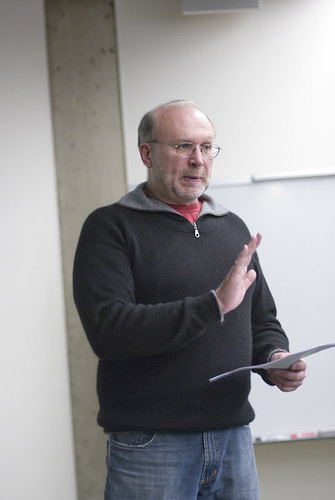
Dave Knowlton is an anthropologist that discussed the form of an "informed consent form". He said that is was putting a space between patient and researcher that could be damaging to research. He wanted to make it so that there is a feeling of equality between those being tested and tester. I think this is slightly idealistic because the tester must be an expert on the subject and must be treated as such. Maybe I think this because I am in my late teens and still respond to authority quite well. I think if there is little to no formality in research conducted this also could be damaging. Knowlton wants research to be more relational than contractual. The informed consent form creates a brick wall to the relational research that Knowlton thinks is optimal. Maybe medical studies and anthropological studies are so distant that medical studies should be more contractual because of legality, whereas anthropological studies are more observation and might not need informed consent forms. There is a problem in his want, because legalities need to be taken care of, especially in research. His want is almost idealistic in its criteria. Won't the casualness of research conducted alter results?
Dave Knowlton is an anthropologist that discussed the form of an "informed consent form". He said that is was putting a space between patient and researcher that could be damaging to research. He wanted to make it so that there is a feeling of equality between those being tested and tester. I think this is slightly idealistic because the tester must be an expert on the subject and must be treated as such. Maybe I think this because I am in my late teens and still respond to authority quite well. I think if there is little to no formality in research conducted this also could be damaging. Knowlton wants research to be more relational than contractual. The informed consent form creates a brick wall to the relational research that Knowlton thinks is optimal. Maybe medical studies and anthropological studies are so distant that medical studies should be more contractual because of legality, whereas anthropological studies are more observation and might not need informed consent forms. There is a problem in his want, because legalities need to be taken care of, especially in research. His want is almost idealistic in its criteria. Won't the casualness of research conducted alter results?
Student Response to "Pharmaceutical Ethics"
By Rachel Draper
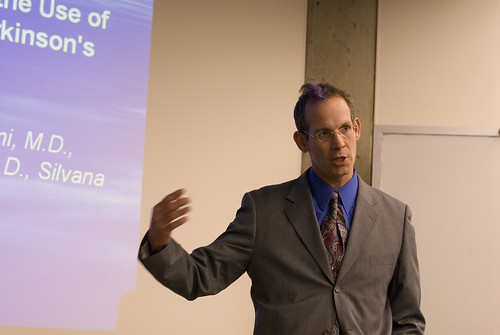
David Yells discussed the politics of pharmaceutical trials and their publications. There are various problems with how the general public is informed about drug experiments. Only positive results are published in medical journals for the obvious reason of negative results seem like bad publicity for the Drug Company and medical journal. I wonder if there is a way that there could be a regulation on the publications of these experiments. Some are disgusted with how much the government interferes with our daily life, but if truth is remaining untold with regards to a drug that I could, would, or should take, then I think something needs to happen. When you watch a TV show you can't get through your episode without seeing a drug commercial or drug test advertisement. The nature of pharmacy is becoming more and more part of our every day lives. The politics of drug representatives is almost nauseating. I’ve seen medical clinics taken to lunch by pharmaceutical representatives at least weekly. These reps "invite" medical doctors to prescribe said drug. I want my treatment to be educated and uninfluenced by where the doctor went to lunch that day. Can the power of money not influence this part of human life? Can politics be set aside in one aspect of life? Curious isn’t it?
David Yells discussed the politics of pharmaceutical trials and their publications. There are various problems with how the general public is informed about drug experiments. Only positive results are published in medical journals for the obvious reason of negative results seem like bad publicity for the Drug Company and medical journal. I wonder if there is a way that there could be a regulation on the publications of these experiments. Some are disgusted with how much the government interferes with our daily life, but if truth is remaining untold with regards to a drug that I could, would, or should take, then I think something needs to happen. When you watch a TV show you can't get through your episode without seeing a drug commercial or drug test advertisement. The nature of pharmacy is becoming more and more part of our every day lives. The politics of drug representatives is almost nauseating. I’ve seen medical clinics taken to lunch by pharmaceutical representatives at least weekly. These reps "invite" medical doctors to prescribe said drug. I want my treatment to be educated and uninfluenced by where the doctor went to lunch that day. Can the power of money not influence this part of human life? Can politics be set aside in one aspect of life? Curious isn’t it?
Student Response to "Detainee Interrogations"
By Rachel Draper
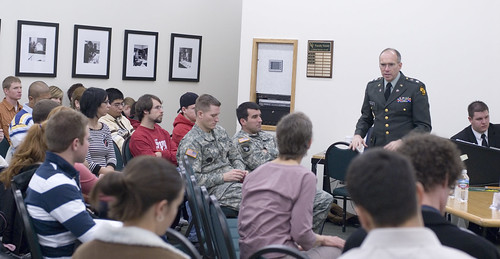
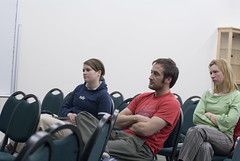
A person commented that he thought it was significant that we were just having a discussion about what happened in Abu Graib. I do think that it was beneficial but significant is questionable. What happened in Abu Graib is staggering. One of the speakers gave the audience a handout that had the link http://www.prisonexp.org/ that would lead you to a slide show of what occurred in AbuGraib. I think that although it was only a small number of soldiers doing terrible things in AbuGraib, it is still unacceptable. I wonder what the punishment will be to those who are in higher position of authority who saw what happened in Abu Graib. I hope the punishment is just. Ron Fischer showed us the new handbook that is for used interrogation of subjects. I see this as almost irrelevant because obviously rules were not kept and people's rights were violated. My questions are: What is going to be done to punish those who saw what happened to those in Abu Graib? How is the military going to keep from this happening again? What can I do to help in this cause? I do see military personnel as a responsible whole but when things like Abu Graib occur it is hard to support the war effort when we are doing the damage. I realize that it is a small occurrence and a very small amount participated in the events of Abu Graib. I still think that the militia should do everything in its power to prevent this from happening again.
A person commented that he thought it was significant that we were just having a discussion about what happened in Abu Graib. I do think that it was beneficial but significant is questionable. What happened in Abu Graib is staggering. One of the speakers gave the audience a handout that had the link http://www.prisonexp.org/ that would lead you to a slide show of what occurred in AbuGraib. I think that although it was only a small number of soldiers doing terrible things in AbuGraib, it is still unacceptable. I wonder what the punishment will be to those who are in higher position of authority who saw what happened in Abu Graib. I hope the punishment is just. Ron Fischer showed us the new handbook that is for used interrogation of subjects. I see this as almost irrelevant because obviously rules were not kept and people's rights were violated. My questions are: What is going to be done to punish those who saw what happened to those in Abu Graib? How is the military going to keep from this happening again? What can I do to help in this cause? I do see military personnel as a responsible whole but when things like Abu Graib occur it is hard to support the war effort when we are doing the damage. I realize that it is a small occurrence and a very small amount participated in the events of Abu Graib. I still think that the militia should do everything in its power to prevent this from happening again.
2,500 and Counting
War Dead Dance
Originally uploaded by Center for the Study of Ethics at UVSC.
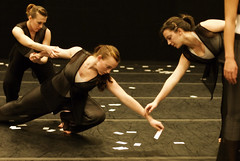
While the bulk of the 2007 Conference by the Faculty consisted of rational discourse, a special treat this year consisted of several "arts" presentations. This image is a capture from one of the most poignant dances I've ever seen, titled 2,500 Dead and Counting.
Back in April of 2006, that was the number of American soldiers killed in Iraq. The number has since continued to grow to 3,188 as of this writing (source: http://www.antiwar.com/casualties/).
A description of this dance will be woefully inadequate, but I wanted to try and convey what was going on in this powerfully moving piece. As a voice intoned the names of soldiers, one after the other (without any pause, just a stream of names articulated) the dancers emerged from the wings and began to lay down small white cards, about the size of a business card, as the names were read. Each time a card was laid down I felt a powerful reminder of a person who was loosing his or her life. It was profoundly moving. The most amazing portion of the dance to me is rather difficult to describe, but this photo illustrates it well, I think. The dancer laying her card down was part of a sequence of dancers that moved through a line of dancers that were supporting them as they struggled through the line, finally laying their cards down as if in death agony.
The dance was choreographed by new UVSC faculty member Angie Banchero-Kelleher. I've since since it a second time. It didn't fail to move me then, either. My thanks to the wonderful students who performed so flawlessly in this performance, and to Angie for her overwhelming use of dance to make a social and ethical comment.
Monday, January 29, 2007
Successful 2007 Conference by the Faculty

This year's faculty conference was a success and came off nicely. We had sessions over two days rather than one and got to hear twice as many great papers from UVSC faculty. We're beginning to collect a sub-set of those papers to publish in the Proceedings. Recently we announced a new process of paying students for blog entries that describe their response to an Ethics Center event, and we're looking forward to the next several entries coming from students who did just that. Also, several faculty may be joining the blogging here, so look for their posts.
In the meantime, photos for the conference are available at:
http://www.flickr.com/photos/ethics/sets/72157594506744787/
These photos are a set within the larger ethics photo collection.
Print ready images are available by clicking on a photo, choosing "all sizes" and downloading the largest size.
Thursday, November 30, 2006
Conference for the Faculty
UVSC's Conference for the Faculty in 2006 Spring Semester
The conference will be on the subject of "Ethics in the Professions". Here is a spreadsheet of presenters and topics.
The conference will be on the subject of "Ethics in the Professions". Here is a spreadsheet of presenters and topics.
Friday, October 27, 2006
Ethikos Bloggers Wanted / Introduction
When I came back to college in my late 40's my second semester was interrupted by the world-view shattering events of 9.11. The very next semester I enrolled in a class that I hoped would shed some light into the dynamics of the world I had come to find myself in suddenly. It was called "Islam and the West" taught by Dr's Brad Cook and David R. Keller. I had only vauge notions of the history of Islam, and was interested in grasping the world stage before events erupted in Manhattan as it related to the players.
The class happened to be an introduction to the Integrated Studies major, and that's how I came to choose it as my major. Not only did that class whet my appetite for knowledge of the world of Islam, but it also introduced me to the myriad of events that were sponsored and coordinated by the Center for the Study of Ethics. David Keller, as its Director, passed around flyers for the various events and offered extra-credit for "response papers" if one attended. That year I attended a facinating seminar on Postmodernism, presentations that gave insight into religious supersessionism and many others. One thing that surprised me was how few students and community members even knew about these events let alone attended them. I mean, they brought the Dalai Lama right here to Utah Valley State College and and I never knew!
One of the greatest times for discussion on campus occurred when the culture war clash of Michael Moore and Sean Hannity came to campus and the Ethics Center hosted a community/faculty/student/administration panel discussion. Despite some of the buffoonery that ensued, it provoked an amazing amount of discussion and lots of mind/soul searching.
The thing is, with less attention, the Ethics Center sponsors events all the time that have the potential to open all sorts of portals into what is going on in the world -- and it's all free and open to the public! Over the past years the Ethics Center has provided a forum for both well-known people like George McGovern, Ralph Nader, Orrin Hatch, Tensin Gyatso, and Sister Helen Prejean as well as the long list of academic and intellectual luminaries like Omar Kader (speaking just yesterday on Iran, how it became a player in the New Middle East and how the U.S. is likely going to engage it), Sandra Steingraber, David Rothenberg, and Baird Calicott to name a few. And then there are all the informed presentations that mine UVSC's own faculty taking advantage of their particular specialty and insight.
So those are a few of the reasons I jumped on the possibility of working for the Ethics Center. I get paid to coordinate and attend these events now. It's like being paid to play. Which brings me to the help wanted section of this introduction. We're interested in paying a stipend of ten dollars to any UVSC student that attends one of these events and writes a "blog response" that we publish. We're also interested in publishing (without the stipend) responses from faculty and adjunct instructors, staff members, administrators and members of the community that attend and respond to these events.
If you're interested in participating, contact me at: lavangdo@uvsc.edu.
Don LaVange
Executive Program Coordinator
UVSC's Center for the Study of Ethics
The class happened to be an introduction to the Integrated Studies major, and that's how I came to choose it as my major. Not only did that class whet my appetite for knowledge of the world of Islam, but it also introduced me to the myriad of events that were sponsored and coordinated by the Center for the Study of Ethics. David Keller, as its Director, passed around flyers for the various events and offered extra-credit for "response papers" if one attended. That year I attended a facinating seminar on Postmodernism, presentations that gave insight into religious supersessionism and many others. One thing that surprised me was how few students and community members even knew about these events let alone attended them. I mean, they brought the Dalai Lama right here to Utah Valley State College and and I never knew!
One of the greatest times for discussion on campus occurred when the culture war clash of Michael Moore and Sean Hannity came to campus and the Ethics Center hosted a community/faculty/student/administration panel discussion. Despite some of the buffoonery that ensued, it provoked an amazing amount of discussion and lots of mind/soul searching.
The thing is, with less attention, the Ethics Center sponsors events all the time that have the potential to open all sorts of portals into what is going on in the world -- and it's all free and open to the public! Over the past years the Ethics Center has provided a forum for both well-known people like George McGovern, Ralph Nader, Orrin Hatch, Tensin Gyatso, and Sister Helen Prejean as well as the long list of academic and intellectual luminaries like Omar Kader (speaking just yesterday on Iran, how it became a player in the New Middle East and how the U.S. is likely going to engage it), Sandra Steingraber, David Rothenberg, and Baird Calicott to name a few. And then there are all the informed presentations that mine UVSC's own faculty taking advantage of their particular specialty and insight.
So those are a few of the reasons I jumped on the possibility of working for the Ethics Center. I get paid to coordinate and attend these events now. It's like being paid to play. Which brings me to the help wanted section of this introduction. We're interested in paying a stipend of ten dollars to any UVSC student that attends one of these events and writes a "blog response" that we publish. We're also interested in publishing (without the stipend) responses from faculty and adjunct instructors, staff members, administrators and members of the community that attend and respond to these events.
If you're interested in participating, contact me at: lavangdo@uvsc.edu.
Don LaVange
Executive Program Coordinator
UVSC's Center for the Study of Ethics
Monday, October 23, 2006
Upcoming Events for October - November
Here is a list of upcoming events here at UVSC's Center for the Study of Ethics. A complete list can always be found here:
On October 26th we will hear from Omar Kader. Mr. Kader is the founder and Past President and CEO of Planning and Learning Technologies. He will speak in LC 243 from 10-11:15 on "The Rising Influence of Iran in the Middle East Conflict: How Did it Happen and What are the Likely Consequences to the US?".
This lecture will be followed by a Faculty Bookgroup, details as follows:
Rashid Khalidi, Resurrecting Empire: Western Footprints and America’s Perilous Path in the Middle East. The discussion will be led by Omar Kader, Founder, Past President and CEO, Planning and Learning Technologies. Event will be held from 3-4:30 p.m. in PS 203. this is sponsored by the UVSC Library. For more information, contact Mike Freeman, Faculty Bookgroup Coordinator.
On October 27 we are hosting the Utah Lake Symposium, Round 2. This will be held from 8 a.m.-5 p.m. in the Faculty Seminar Room (LC 243). this event is cosponsored with the June Sucker Recovery Implementation Program, the School of Science and Health, and the Environmental Studies Program.
On November 1 for our regular Monthly Ethics Forum we welcome David Irvine, Brigadier General, U.S. Army (retired) speaking on “Tortured Times for American Values” from 7:00-8:30 p.m. in the Faculty Seminar Room (LC 243).
On November 2, U.S. Congressman Chris Cannon will speak on “Ethics, Democracy, and Politics” in LA 025 at 10:00 a.m. This event is co-sponsored by the Center for the Study of Ethics, and The Office of the President.
On November 3 we welcome U.S Senator Bob Bennett at 10:00 am in LA 023. This event is co-sponsored by the Center for the Study of Ethics, The Office of the President, ASUVSC, and professor Dennis Farnsworth.
Finally on November 9 from 11:30 a.m.-12:45 p.m. in the Faculty Seminar Room (LC 243) our Lunchtime Ethics Open Discussion we will feature a panel discussion entitled: “Lies that Tell the Truth: Creative Writers as Ethicists”. The panel is made up of:
Rob Carney, Associate Professor, English and Literature, UVSC
Stephen D. Gibson Assistant Professor, English and Literature, UVSC
For more information or questions call 801.863.6455.
On October 26th we will hear from Omar Kader. Mr. Kader is the founder and Past President and CEO of Planning and Learning Technologies. He will speak in LC 243 from 10-11:15 on "The Rising Influence of Iran in the Middle East Conflict: How Did it Happen and What are the Likely Consequences to the US?".
This lecture will be followed by a Faculty Bookgroup, details as follows:
Rashid Khalidi, Resurrecting Empire: Western Footprints and America’s Perilous Path in the Middle East. The discussion will be led by Omar Kader, Founder, Past President and CEO, Planning and Learning Technologies. Event will be held from 3-4:30 p.m. in PS 203. this is sponsored by the UVSC Library. For more information, contact Mike Freeman
On October 27 we are hosting the Utah Lake Symposium, Round 2. This will be held from 8 a.m.-5 p.m. in the Faculty Seminar Room (LC 243). this event is cosponsored with the June Sucker Recovery Implementation Program, the School of Science and Health, and the Environmental Studies Program.
On November 1 for our regular Monthly Ethics Forum we welcome David Irvine, Brigadier General, U.S. Army (retired) speaking on “Tortured Times for American Values” from 7:00-8:30 p.m. in the Faculty Seminar Room (LC 243).
On November 2, U.S. Congressman Chris Cannon will speak on “Ethics, Democracy, and Politics” in LA 025 at 10:00 a.m. This event is co-sponsored by the Center for the Study of Ethics, and The Office of the President.
On November 3 we welcome U.S Senator Bob Bennett at 10:00 am in LA 023. This event is co-sponsored by the Center for the Study of Ethics, The Office of the President, ASUVSC, and professor Dennis Farnsworth.
Finally on November 9 from 11:30 a.m.-12:45 p.m. in the Faculty Seminar Room (LC 243) our Lunchtime Ethics Open Discussion we will feature a panel discussion entitled: “Lies that Tell the Truth: Creative Writers as Ethicists”. The panel is made up of:
Rob Carney, Associate Professor, English and Literature, UVSC
Stephen D. Gibson Assistant Professor, English and Literature, UVSC
For more information or questions call 801.863.6455.
Senator Gordon H. Smith
Senator Gordon H. Smith
Originally uploaded by Center for the Study of Ethics at UVSC.
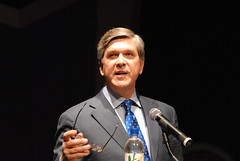
Senator Smith spoke today on the topic of suicide prevention. The Senator's son, Garrett, took his own life while a UVSC student. The Senator, and his wife Sharon, shared the story of Garrett's life-long depression and the events leading up to his taking his life. Senator Smith spent a portion of the talk telling the large Ragan Theatre audience how to spot the signs of depression. He gave a list of things to not do, such as telling the depressed person to just get to work and stop being depressed or daring them to take their life. He stressed that a good friend of a depressed person would take active efforts to insure there were no fire-arms or life-threatening drugs available to the person, and not agreeing to keeping suicidal confidences.
After the speech, Senator Smith and his wife Sharon fielded questions from the audience.
Friday, October 13, 2006
Upcoming Events
Early one fall semester at Utah Valley State College, student Garrett Smith succumbed to a lifelong depression and took his own life. His devasted family, including Oregon Senator Gordon H. Smith (R, Oregon) found their lives changed forever. Senator Smith wrote a book about the experience, Remembering Garrett and sponsored legislation that would fund higher education to combat severe student depression.
On October 23rd we welcome Senator Smith as he continues his education crusade on suicide in young people. Utah has devastatingly high suicide rates, and UVSC seems to have an even higher rate.
Join us on 10/23/2006 at 10-11:30 in the Ragan Theatre for an informative and welcome presentation.
On October 23rd we welcome Senator Smith as he continues his education crusade on suicide in young people. Utah has devastatingly high suicide rates, and UVSC seems to have an even higher rate.
Join us on 10/23/2006 at 10-11:30 in the Ragan Theatre for an informative and welcome presentation.
Subscribe to:
Posts (Atom)